Why choosing equipment is a strategic decision
In Benin, a growing number of farmers and agricultural entrepreneurs are looking to mechanize certain operations in order to save time, reduce the physical strain of the work and increase their production capacity. Tractors, power tillers, motor pumps, irrigation systems, sprayers, seed drills, processing equipment, harvesting machines, generators and livestock equipment: the options are many. But this variety also creates a problem: which equipment should you choose?
Some producers buy a machine because it looks powerful, others because the price seems attractive, and others rely solely on a salesperson's recommendations. Then the problems start: repeated breakdowns, excessive fuel consumption, hard-to-find spare parts, no technician available, an underused machine, poor settings, insufficient output and high maintenance costs.
A high-performance machine is not always the right one
A machine can look excellent on paper and still be unsuited to a particular farm, because farm equipment must be chosen according to the actual production system: the area farmed, the soil type, the crops, the frequency of use, the availability of labor, access to spare parts and the possibilities for maintenance.
| What people often look at | What they should also look at |
|---|---|
| Purchase price | Total cost of use |
| Power | The farm's actual needs |
| Brand | Availability of after-sales service and parts |
| Appearance of the machine | Robustness and suitability for the terrain |
| Advertised performance | Performance in real-world conditions |
| Novelty | Ease of maintenance |
| Maximum capacity | Actual production needs |
| The seller's offer | Cost and availability of support |
The best equipment is not necessarily the most powerful, the most modern or the most expensive. It is the one that properly meets the need it was bought for.
The purchase-price trap and hidden costs
The purchase price is naturally important, but it should never be the only criterion. A machine that is cheaper to buy may use more fuel, need frequent repairs and have spare parts that are hard to find — at which point the economics change completely.
| Cost items | Machine A | Machine B |
|---|---|---|
| Purchase price | Low | Higher |
| Consumption | High | Moderate |
| Maintenance | Frequent | Regular |
| Spare parts | Hard to find | Available |
| Production stoppages | Numerous | Limited |
| Service life | Shorter | Longer |
When a machine breaks down, the bill is not limited to the cost of the repair: part, labor, transport, the machine sitting idle, delays in the work and possibly renting another machine. Some losses are even harder to measure: if the machine breaks down at the wrong moment, the consequences can far exceed the cost of the repair.
A poorly chosen machine disrupts the whole chain
Take a producer who invests in irrigation equipment. The equipment may work technically, but if it is poorly sized for the area, the water source or the crops' needs, the system may not deliver the expected results. The same logic applies to a motor pump, a tractor, a sprayer, a crusher or a processing unit: the equipment must be assessed within its production environment, not in isolation.
Another mistake is buying a machine for an occasional need. If the cost of acquisition, maintenance, storage and depreciation is high for use over just a few days a year, renting or hiring a service provider can sometimes make more economic sense.
| Situation | Option to consider |
|---|---|
| Very frequent use | Buying may be worthwhile |
| Occasional use | Compare renting or hiring a service |
| Need shared among several producers | Pooling may be possible |
| Very expensive machine | In-depth economic study |
| Seasonal need | Compare buying vs. renting |
The goal is to choose a mechanization solution, not necessarily to own a machine.
Support, training and spare parts
The purchase is made, the machine is delivered, a quick demonstration is sometimes given — and then the producer is left on their own. Yet farm machinery often requires more than a simple delivery: training the operators, explaining the settings, setting up a maintenance schedule and learning to spot the first signs of malfunction.
| Before the purchase | After the purchase |
|---|---|
| Needs analysis | User training |
| Model selection | Commissioning |
| Technical study | Settings and adjustments |
| Comparing options | Preventive maintenance |
| Checking the cost | Technical support |
There is a lot of talk about the quality of equipment, but much less about the person who will use it. Poor use can lead to incorrect settings, excessive consumption, premature wear or poor work quality. Buying a machine should therefore raise one simple question:
Likewise, if a key part has to be ordered from abroad after every breakdown, the farm can be left idle for a long time. Before buying, it is worth checking which parts wear out regularly, where they are available and how long it takes to get them.
After-sales service and total cost of ownership
"We provide after-sales service" may sound reassuring, but it deserves to be spelled out: what type of service, for how long, with which technicians, in which area, at what cost and with what response time? The producer should ask these questions before buying, not after the first breakdown.
| Question to ask the supplier | Why it matters |
|---|---|
| Where can I find the parts? | Reduce downtime |
| Who handles maintenance? | Identify who to contact |
| What is the response time? | Anticipate stoppages |
| Is training included? | Ensure proper use |
| Is there a warranty? | Reduce certain financial risks |
To make a good decision, you need to go beyond the question "how much does this machine cost?" and ask instead "how much will this machine actually cost me over its service life?" The total cost may include the purchase price, transport, installation, training, fuel, maintenance, spare parts, labor, repairs and downtime.
Avoiding the most common mistakes
"My neighbor uses this machine and it works very well" is useful information, but not always a sufficient justification: two farms can have very different acreage, soil, crops and labor. Another farmer's experience must be put back in the context of your own farm.
Before choosing equipment, it is best to start with a diagnosis: which operation do we want to mechanize, what area or volume do we need to handle, how often will the equipment be used, what are the constraints of the terrain, who will operate it, how will maintenance be ensured, and what is the total cost of the project?
| Mistake | Risk |
|---|---|
| Choosing on price alone | Future costs underestimated |
| Buying an oversized machine | Investment hard to make profitable |
| Buying an undersized machine | Insufficient productivity |
| Neglecting maintenance | Breakdowns and downtime |
| Neglecting training | Improper use |
| Copying another producer's choice | Equipment unsuited to the context |
| Not calculating the total cost | Poor estimate of profitability |
| Not planning for after-sales service | Difficulties after the purchase |
Treating mechanization as an investment
Equipment that is cheaper to buy can end up costing more to run — but the reverse is also true: an expensive but underused machine can also be a poor decision. So the question is not "which machine is the cheapest" or "which machine performs best", but:
When properly chosen and used, farm machinery can help increase work capacity, reduce some of the more arduous tasks, make operations more consistent and make it easier to expand the farm. But these benefits depend on how the equipment is selected, installed, used and maintained.
| Symptom | Possible causes to examine |
|---|---|
| Low output | Poor settings, unsuitable capacity, improper use |
| Repeated breakdowns | Insufficient maintenance, improper use, operating conditions |
| High consumption | Settings, overload, maintenance or working conditions |
| Poor work quality | Insufficient training, unsuitable settings |
| Long downtime | Parts unavailable or inadequate after-sales service |
High-performance equipment can deliver poor results if it is badly integrated into the farm. Good support should therefore not start on the day the machine arrives, but before the purchase decision.
Towards a tailor-made solution
Not every farmer can be a specialist in engines, hydraulics, irrigation or mechanization — and they do not need to be. Depending on the project, it can be useful to call on an agronomist, a mechanization specialist, a maintenance technician or an equipment advisor.
The real shift in thinking is to stop asking "which machine can you sell me?" and ask instead "which problem do I need to solve on my farm?" Only then does the question of equipment arise — and sometimes the solution will not be a purchase, but a rental, a mechanization service, pooling among producers or a combination of several solutions.
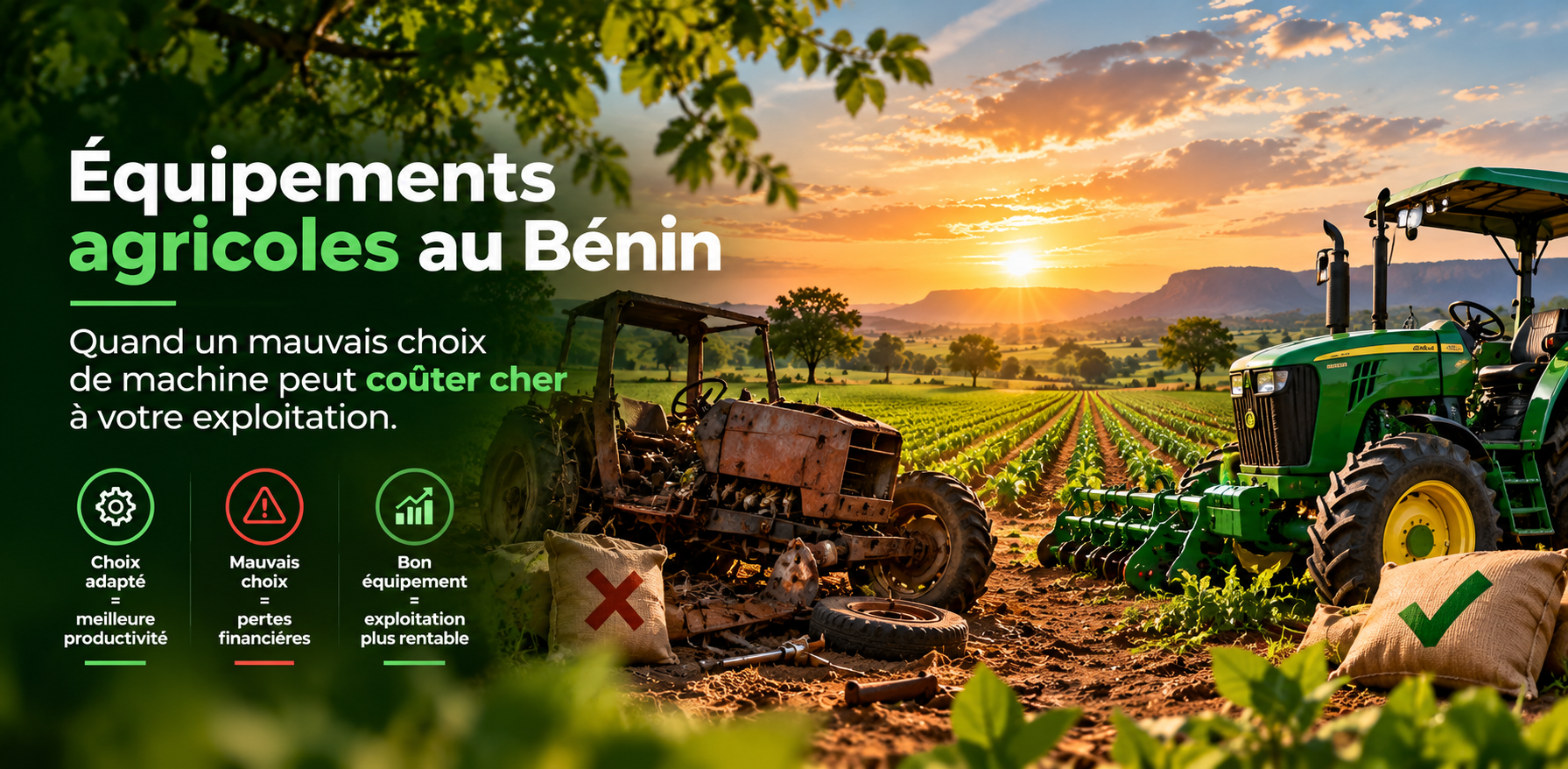
The wrong equipment, poorly sized, misused or badly maintained, can turn an investment into a source of expenses. Conversely, equipment chosen on the basis of a real diagnosis, suited to the production system and backed by technical follow-up can become a genuine productivity lever.
Key takeaways
The best equipment is not the most powerful or the most expensive; it is the one suited to the actual production system.
The purchase price is not enough: think in terms of total cost of ownership over the whole service life.
A machine without training, available parts and solid after-sales service quickly becomes a risky investment.
Another producer's experience must always be put back in the context of your own farm.
Seeking advice before buying always costs less than correcting a bad decision afterwards.